
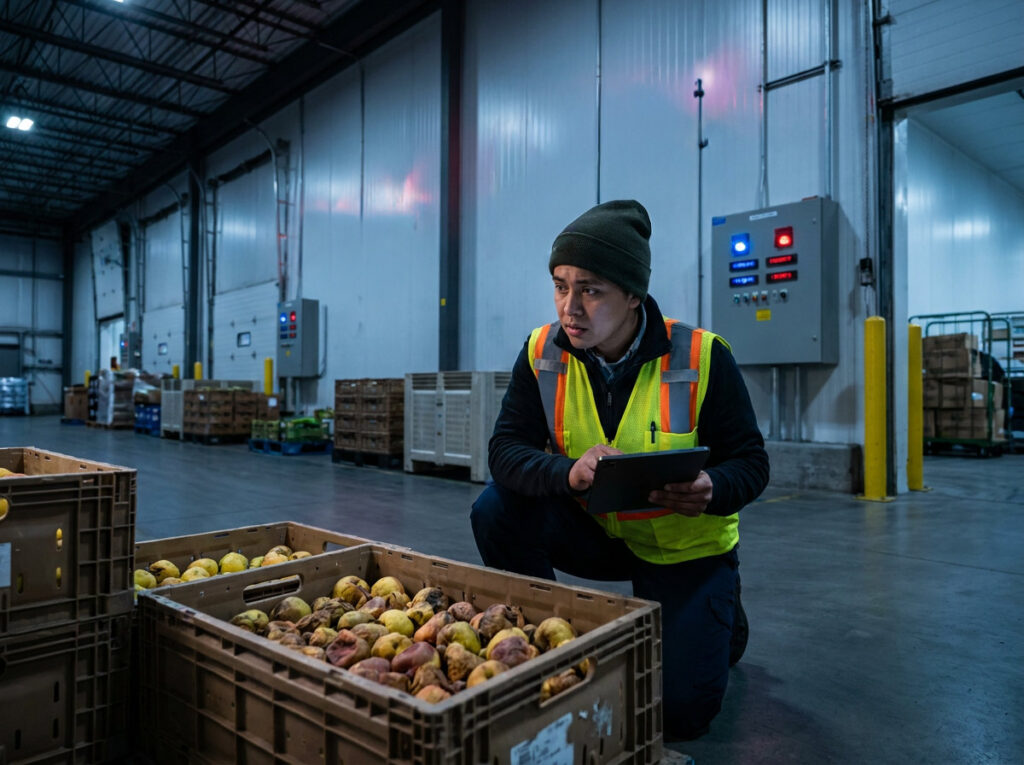
Every business decision involves tradeoffs, and cold storage is no exception. When capacity is tight, companies make compromises — holding product a little longer in staging, stretching a refrigerated section past its designed load, or skipping supplemental storage because it feels like an unnecessary expense.
Those compromises have costs. They’re just not always visible on the P&L until something goes wrong. Here are five of the most common hidden costs of inadequate cold storage — and what you can do about each one.
1. Spoilage That Gets Written Off as “Normal Loss”
Most businesses that experience regular cold chain stress have a spoilage number they’ve normalized. It shows up in inventory write-offs, and over time it becomes just part of the cost of doing business.
But normalized spoilage is a sign of a structural problem, not an industry inevitability. When product is consistently held at marginal temperatures — just outside spec but not obviously failing — it degrades faster, has shorter shelf life when it reaches the customer, and generates return and refund activity that the original spoilage write-off doesn’t capture.
The hidden cost: If your operation has a spoilage rate that feels “normal” but isn’t zero, that delta is a direct result of cold storage constraints. Eliminating it with a properly sized cold storage solution almost always costs less than the spoilage itself.
2. Customer Complaints and Returns You Don’t Attribute to Cold Chain
Short shelf life complaints. Product that arrived “off.” A restaurant partner who quietly shifted some of their volume to a different supplier because your product wasn’t as consistent as they needed.
These outcomes have roots in cold chain performance, but they rarely get coded as cold storage failures in your CRM or complaint log. They get logged as product quality issues, logistics issues, or just customer churn.
The hidden cost: Difficulty in attributing this cost doesn’t mean the cost isn’t real. If your cold chain has weak links, your customer relationship quality is reflecting that — even if the connection isn’t obvious.
3. Expedited Logistics When Capacity Isn’t There
When your cold storage fills up unexpectedly, the solution usually involves paying a premium for something: expedited off-site cold storage, charter refrigerated transport, rushed reorder of product that had to be discarded, or overtime labor to manage the overflow.
These costs are easy to identify — they show up as unplanned line items in a given week. But they’re almost never tracked against the underlying cause (insufficient cold storage capacity) and therefore never prompt a structural fix.
The hidden cost: Frequent expedited logistics expenses are usually far more expensive than the supplemental cold storage rental that would have prevented them.
4. Compliance Risk From Informal Workarounds
Businesses under cold storage pressure develop informal workarounds: staging product in areas not rated for cold storage, using consumer-grade refrigeration for commercial volumes, or relying on “it’s only for a few hours” logic that doesn’t hold up in an audit.
These workarounds are rarely malicious. They’re the result of real operational pressure and the pragmatic choices people make to keep things moving. But they create genuine compliance exposure.
The hidden cost: In California’s regulatory environment, a single documented temperature deviation — or worse, a routine that gets flagged during a supplier audit — can cost you a key account or trigger a formal compliance investigation. The cost of that outcome dwarfs the cost of doing it right.
5. Supplier and Retail Partner Relationship Erosion
Large grocery chains and institutional food service accounts have supplier compliance programs for a reason. They track quality metrics, temperature documentation, and incident history for every supplier in their network.
Businesses that consistently underperform on cold chain metrics — even without a dramatic failure event — see their supplier ratings erode over time. Lower ratings mean less favorable shelf positioning, smaller order volumes, and eventually getting cycled out of the supplier pool.
The hidden cost: Losing a major retail account due to cold chain performance issues is rarely a sudden event. It’s a slow erosion that becomes obvious in hindsight. By the time the relationship is at risk, the pattern that caused it has been running for months.
The Common Thread: Avoidable With the Right Capacity
Every hidden cost on this list has the same underlying cause — cold storage capacity that doesn’t match operational demand — and the same general solution: right-sizing your cold storage with a flexible, reliable supplemental option.
Portable refrigerated containers give California businesses the ability to expand cold storage capacity without long-term real estate commitments, and to do it quickly enough to respond to changing demand patterns before those demand patterns create problems.
A&S Reefers: Reliable Cold Storage That Protects Your Business
A&S Refrigerated Containers helps California businesses avoid the hidden costs of cold chain gaps with reliable rental, sales, and maintenance service throughout the state. Fast delivery, 24/7 support, and honest pricing make it straightforward to get the capacity you need.
Visit asreefers.com or call 1-855-265-3911 for a free quote and consultation.