
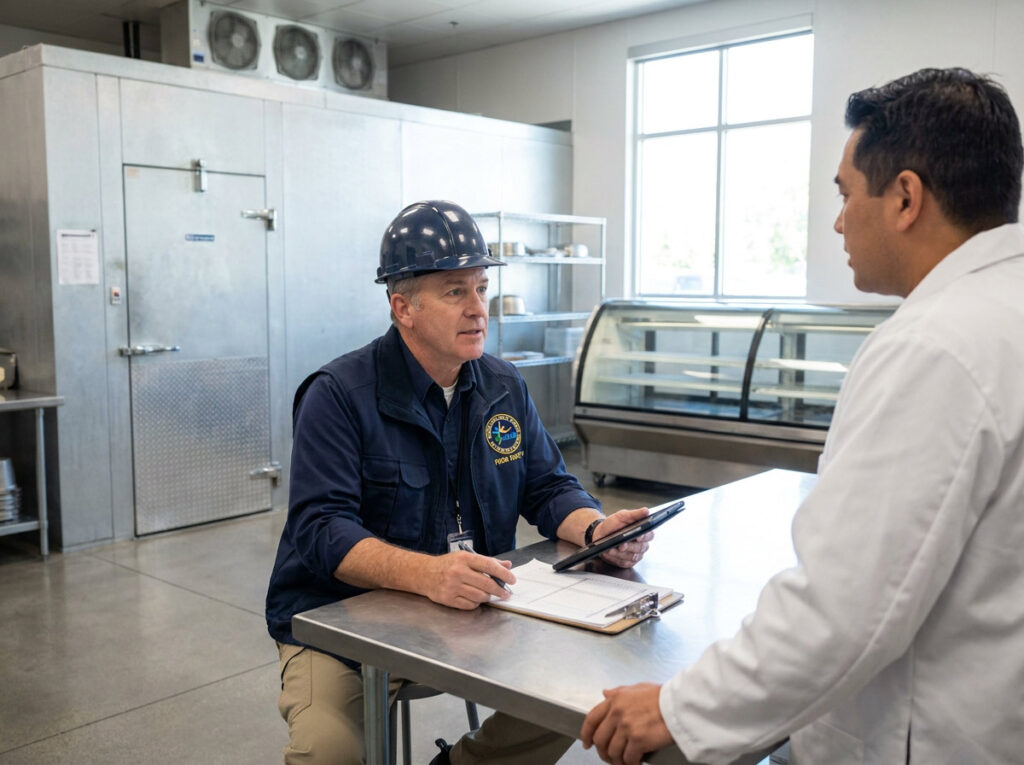
If your business handles temperature-sensitive food products in California, your cold storage isn’t just an operational concern — it’s a compliance requirement with legal and regulatory teeth. The state of California and the federal Food and Drug Administration both impose specific requirements on how cold storage must be managed, documented, and maintained. Understanding those requirements is table stakes for any medium or large food business operating in the state.
The Federal Framework: FDA and FSMA
The Food Safety Modernization Act (FSMA), signed into law in 2011 and implemented in phases through subsequent years, fundamentally shifted the FDA’s approach to food safety from response to prevention. Under FSMA, food businesses are required to implement documented preventive controls — including temperature control for cold-stored product — rather than simply responding to food safety incidents after the fact.
Key FSMA provisions relevant to cold storage:
21 CFR Part 117 (Current Good Manufacturing Practice, Hazard Analysis, and Risk-Based Preventive Controls): Requires that temperature controls be identified as part of a written food safety plan, with documented monitoring procedures, corrective actions, and verification records.
21 CFR Part 1, Subpart O (Sanitary Transportation of Human and Animal Food): Establishes requirements for temperature control during food transport, including refrigerated vehicles and containers used for transport.
Temperature range requirements: FDA guidance for refrigerated food storage generally calls for temperatures at or below 40°F (4°C) for most perishable food products, though specific requirements vary by product category.
California State Regulations
Beyond federal requirements, California imposes its own food safety regulatory layer through the California Department of Public Health (CDPH) and the California Department of Food and Agriculture (CDFA).
California Retail Food Code (CalCode): Establishes specific requirements for cold holding temperatures (41°F or below for most potentially hazardous foods), monitoring and logging requirements, and equipment standards for food businesses subject to local health department oversight.
CDFA regulations for food processors and distributors: California food processors and distributors are subject to CDFA licensing and inspection, which includes cold storage requirements and documentation standards.
County health department requirements: Local county health departments in the Bay Area — San Mateo, Santa Clara, Alameda, San Francisco — each apply CalCode requirements with their own inspection programs and enforcement priorities. What passes inspection in one county may face more scrutiny in another.
What These Regulations Require of Your Cold Storage Setup
In practical terms, regulatory compliance for cold storage means your setup must:
Maintain documented temperatures. You need calibrated temperature monitoring equipment and records that demonstrate your cold storage maintained required temperatures over time. Spot-checking isn’t sufficient for most regulatory frameworks — continuous monitoring with a data log is increasingly the expected standard.
Have documented response procedures for deviations. Your food safety plan must specify what happens when temperature monitoring shows a deviation — who gets notified, what product hold procedures apply, and how the situation gets resolved and documented.
Use equipment capable of meeting specifications. The refrigeration equipment you use must be capable of maintaining required temperature ranges under normal operating conditions, including during hot California summers when ambient temperatures stress refrigeration systems more heavily.
Meet sanitation requirements. Cold storage equipment must be cleanable and maintained in a sanitary condition. This includes interior surfaces, drainage, and door seals.
Maintain calibration records. Temperature monitoring equipment must be calibrated on a documented schedule to ensure accuracy.
Common Compliance Gaps in Cold Storage Operations
The most frequent compliance issues that arise in food business cold storage inspections:
- Inadequate temperature records — no data logger, or records with gaps
- Equipment that can’t maintain required temperatures under load — cold storage that performs acceptably when empty but can’t maintain temperature when fully loaded in warm weather
- No documented corrective action procedure for temperature deviations
- Using non-commercial refrigeration for commercial food storage — consumer-grade refrigerators lack the capacity and consistency required for regulated applications
- Inadequate separation of product types — raw and ready-to-eat products improperly stored in proximity
How Portable Containers Support Compliance
Commercial-grade refrigerated containers — the type used in food logistics and food service — are purpose-built to meet commercial food storage requirements. Their refrigeration systems are designed for continuous operation under load, their interiors are cleanable, and they’re capable of maintaining required temperature ranges.
For California food businesses using temporary or supplemental cold storage, portable containers from a reputable provider are typically a better compliance answer than improvised solutions using non-commercial equipment.
A&S Reefers: Compliant Cold Storage for California Food Businesses
A&S Refrigerated Containers provides commercial-grade refrigerated containers that meet the operational requirements of California’s food safety regulatory environment. Their team can help you identify the right unit for your application and provide the technical documentation you need for your compliance records.
Visit asreefers.com or call 1-855-265-3911 for a consultation on your cold storage compliance needs.