
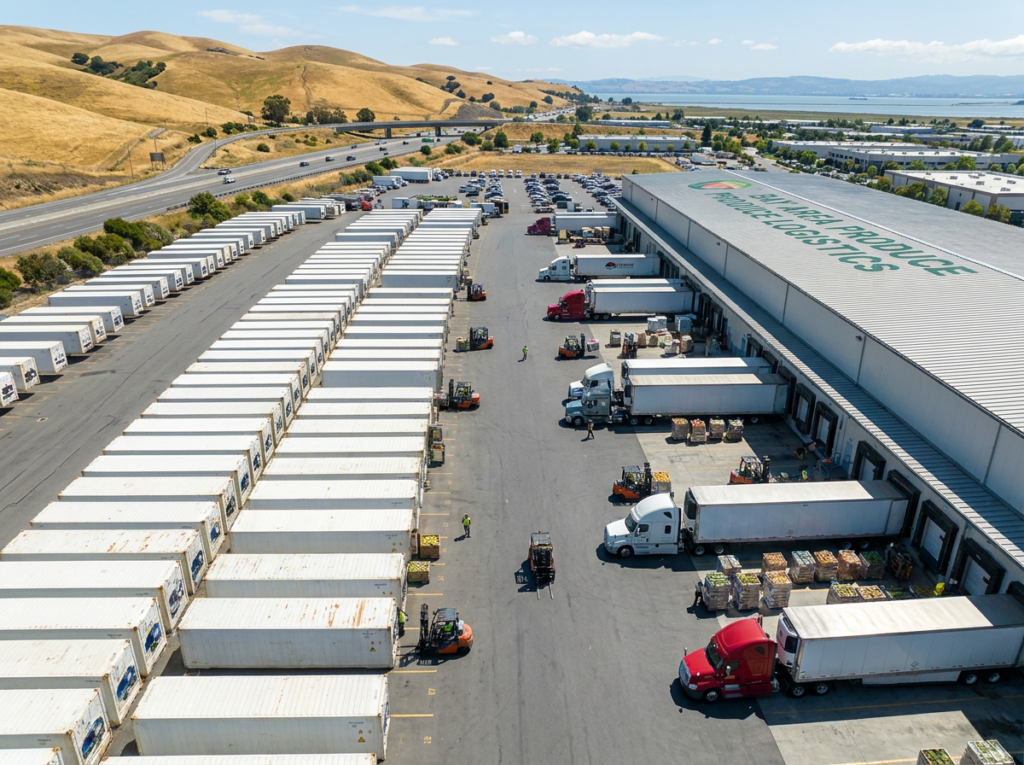
he Bay Area food distribution industry operates in one of the most demanding cold storage environments in the country. Between the region’s agricultural richness — producing everything from Napa Valley wine to Central Valley produce — and its dense concentration of grocery chains, restaurant groups, and institutional food service accounts, the volume of temperature-sensitive goods moving through Bay Area distribution operations is immense.
And it’s not constant. It surges.
The Overflow Problem in Bay Area Distribution
Food distribution in California is defined by cyclical demand. Produce seasons, holiday surges, promotional buying events, and supply chain consolidations all create windows where inbound volume exceeds the designed throughput capacity of a distribution center’s refrigerated section.
When that happens, the choices are typically unpleasant:
- Hold incoming product in staging that isn’t properly conditioned
- Pay premium rates for third-party cold storage that may be miles away
- Turn away orders or push deliveries that your retail partners are counting on
- Rush to find short-term solutions at whatever cost the market demands on short notice
None of these are good outcomes. And for businesses that experience them repeatedly — multiple times per year, on a predictable seasonal cadence — they represent a structural problem, not a one-time exception.
The Temporary Container Solution
The Bay Area food distributors who have moved beyond this cycle share a common approach: they treat temporary refrigerated container rental as an integrated part of their cold storage planning, not as an emergency response.
Rather than scrambling to find overflow cold storage when inbound volume exceeds capacity, they pre-position reefer containers on their property two to four weeks before known peak periods. When the surge arrives, they have cold, ready capacity waiting — not a logistics problem to solve in real time.
How the Model Works in Practice
Pre-season planning: A distributor identifies their peak inbound windows for the year — typically aligned with major produce seasons, holiday periods, or known promotional events with major grocery chain partners. They determine how much overflow cold storage each peak window typically requires.
Container rental booking: Two to six weeks before each peak window, they arrange container delivery from A&S Refrigerated Containers. Units are sized to match anticipated overflow volume, and they’re placed in staging yards adjacent to receiving docks.
Integrated operations: During the peak window, overflow product moves directly from receiving into the container. Product flows back into the primary facility as space opens up and outbound orders clear inventory.
Post-peak return or extension: When the peak subsides, containers are returned or — if the next peak is approaching — simply held and refreshed.
The Site Requirements Are Minimal
One of the practical barriers distributors often cite for on-site container storage is site preparation. In reality, the requirements are modest:
- A level surface area — concrete, asphalt, or compacted gravel — large enough for the container footprint
- Three-phase or single-phase power access appropriate to the unit specification
- Adequate truck access for delivery and pickup
Most established distribution facilities already meet these requirements. Some need minor electrical work to bring power to the staging area; that’s typically a one-time investment that pays for itself across many seasons of use.
What Bay Area Distributors Report
Distributors who integrate temporary cold storage into their seasonal planning consistently report the same benefits:
- Reduced spoilage and quality incidents during peak periods, because product moves from receiving into a conditioned environment immediately
- More predictable operations during high-volume periods, because the logistics team isn’t managing a cold storage crisis while also trying to hit outbound delivery windows
- Stronger supplier and retail partner relationships, because the distributor can confidently commit to receiving and delivering product during peak windows without qualification
- Lower total cost compared to emergency off-site cold storage or spoilage write-offs that characterized the old model
A&S Reefers: The Bay Area Cold Storage Partner for Distributors
A&S Refrigerated Containers has worked with Bay Area food distribution operations of all sizes, providing fast delivery, reliable units, and the 24/7 service support that distribution operations require. Their team understands the cyclical nature of distribution demand and can work with your planning calendar to ensure containers are in place when you need them.
Get ahead of your next peak. Visit asreefers.com or call 1-855-265-3911 for a free quote.