
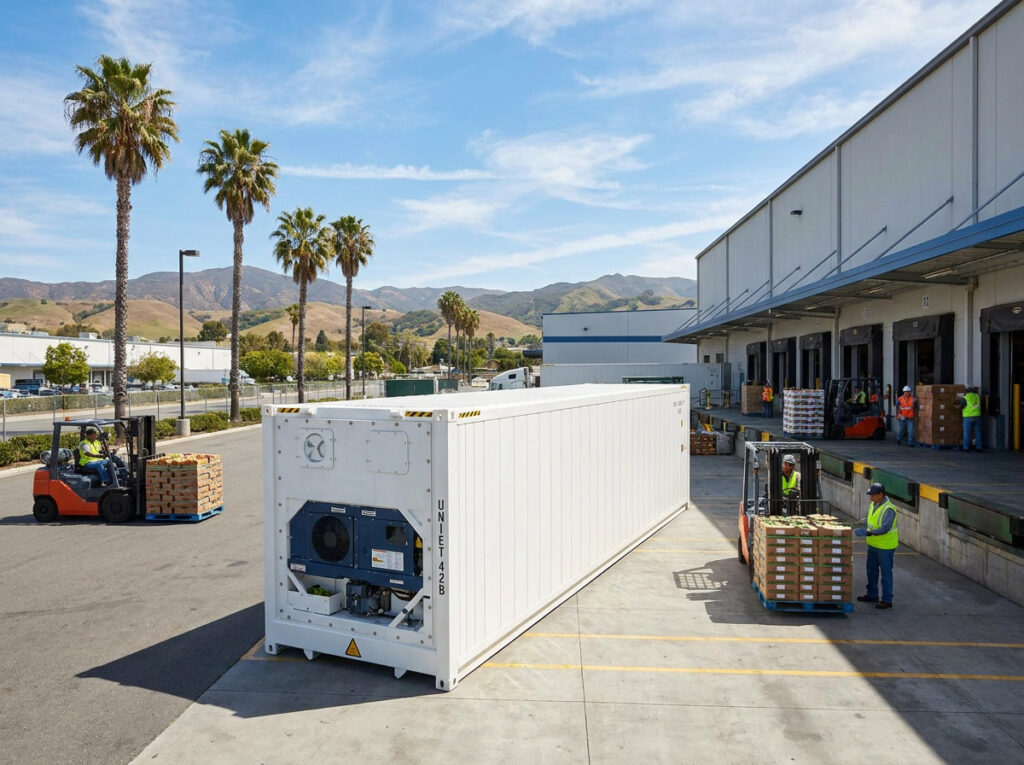
Distribution centers in California are under more pressure than ever. Rising lease rates, labor shortages, and ever-tighter delivery windows have pushed many facilities to run at or near capacity — leaving little buffer when volume spikes unexpectedly.
For businesses that rely on refrigerated product, that buffer problem is compounded. Cold storage space is scarcer, more expensive, and harder to scale than ambient warehouse space. When a refrigerated section fills up, there aren’t many good options — until you look outside the building.
The On-Site Container Strategy
A growing number of California food distributors, grocery operations, and food manufacturing companies have discovered that placing refrigerated containers directly on their existing property — in a staging yard, near a loading dock, or in an overflow area — solves the capacity problem without the complexity of leasing additional cold storage space.
The logic is straightforward: the distribution center is the hub, and the on-site container is the expansion valve. When cold storage inside fills up, overflow inventory goes into the container. Product flows in and out as needed, and the internal facility maintains efficient throughput without the gridlock that comes from being overstuffed.
Why On-Site Placement Changes the Equation
Moving product to an off-site cold storage facility sounds like a solution, but it introduces problems of its own:
- Transportation cost and time. Every move to an off-site facility adds a trip, fuel cost, handling risk, and time — and in cold chain management, time and temperature are linked.
- Inventory visibility. Product at a separate location is harder to monitor, harder to access quickly, and easier to lose track of in fast-moving operations.
- Cold chain continuity. Each transfer between facilities is an opportunity for a temperature deviation. Fewer transfers mean a more reliable chain.
An on-site reefer container eliminates all three of those problems. Product stays within your operational footprint, inventory stays visible and accessible, and cold chain continuity is maintained because the product barely moves.
Real Applications Across California Industries
Food distributors use on-site containers to handle produce and dairy overflow during peak shipping seasons — particularly in the weeks before major holidays when inbound volume from California’s agricultural regions exceeds normal warehouse capacity.
Grocery distribution operations use them to buffer between supplier deliveries and outbound store replenishment, especially when timing mismatches create temporary cold storage overload.
Food manufacturers position containers near production lines to hold finished goods awaiting outbound pickup, keeping the production floor clear and the cold chain unbroken from manufacturing to dispatch.
Beverage companies — particularly wine and craft beer producers in the Bay Area — use on-site containers to maintain temperature-controlled inventory near tasting rooms, distribution hubs, or event facilities without the overhead of a dedicated cold room.
What You Need to Make It Work
The practical requirements for an on-site reefer container are minimal:
- A level surface — a concrete pad, asphalt lot, or compacted gravel area large enough for the container footprint
- Power access — most reefer containers run on standard three-phase commercial power; some units operate on single-phase, which is more commonly available at smaller facilities
- Clearance for delivery — a standard flatbed or tilt-bed truck needs reasonable access to position the container
Beyond those basics, delivery can typically happen within 24 to 48 hours of confirming an order, and the unit is operational the same day it’s placed.
Seasonal Flexibility Without Long-Term Commitment
One of the underrated advantages of the on-site container model is that it’s inherently seasonal. Businesses can scale up cold storage capacity for the months they need it and return units when they don’t — without carrying the fixed cost of a permanent cold storage expansion year-round.
For a distribution center that runs at 90% cold storage capacity for four months of the year and 60% capacity for the rest, a rental model makes far more financial sense than permanent buildout.
A&S Reefers: Serving California Distribution Operations
A&S Refrigerated Containers delivers and services reefer units throughout California, with same-day quotes and fast turnaround. Their 24/7 maintenance support means if something needs attention with your on-site unit, it gets handled — not during business hours next week, but now.
Find out how on-site cold storage can reduce the pressure on your distribution center. Get a free quote online or call 1-855-265-3911 for a free quote.