
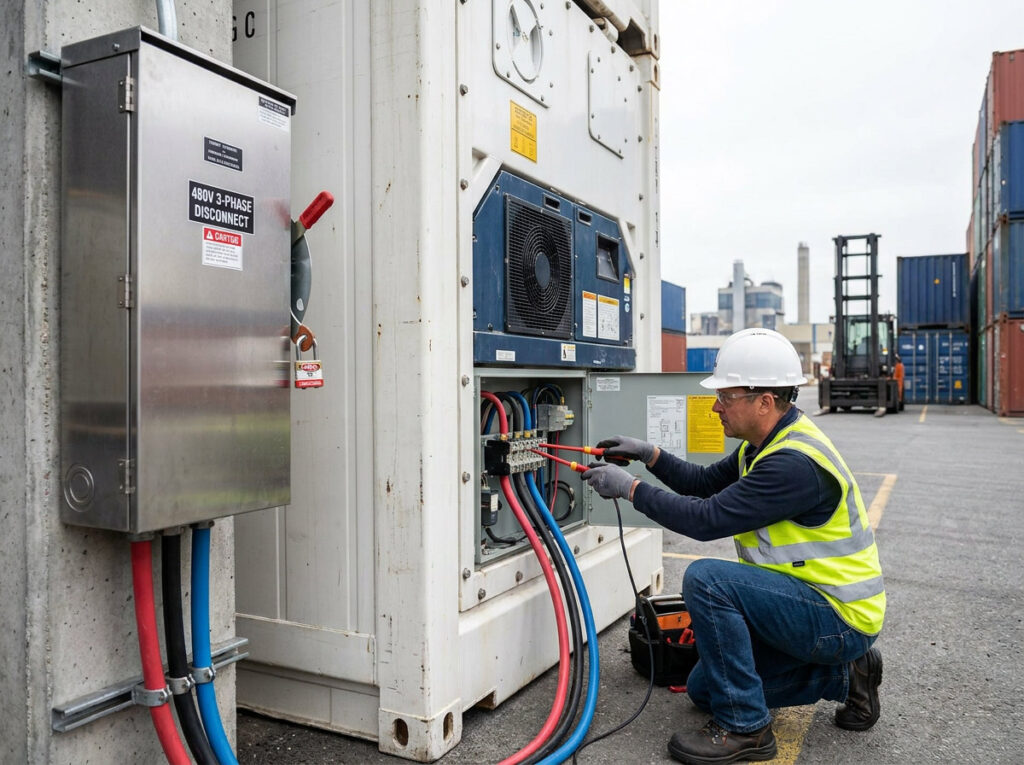
Power supply is one of those details that seems technical and unimportant — right up until your refrigerated container arrives and you discover your facility doesn’t have the right electrical connection. It’s one of the most common practical obstacles in reefer container deployments, and it’s entirely avoidable with a five-minute conversation before the truck leaves.
Here’s what you need to know.
The Basics: What’s the Difference?
Electrical power is distributed in two main configurations for commercial applications:
Single-phase power is the type most people are familiar with. It’s what runs residential homes and smaller commercial spaces — standard 120/240V outlets. Single-phase power delivers one alternating current wave.
Three-phase power uses three alternating current waves offset 120 degrees from each other. It’s the standard for commercial and industrial facilities because it’s more efficient for running motors and heavy equipment. Three-phase power delivers more consistent power with less fluctuation, which is why refrigeration systems favor it.
The practical upshot: most refrigerated container units are designed for three-phase power. Some smaller or specialty units are available in single-phase configurations.
Why Reefer Containers Typically Require Three-Phase Power
Refrigerated containers are built around commercial refrigeration units — typically Thermo King or Carrier systems — that use compressor motors to maintain temperature. Compressor motors run more efficiently and with less electrical stress on three-phase power.
The advantages for reefer applications:
- More consistent temperature control, because power delivery to the compressor is more stable
- Better performance during summer heat, when the compressor works harder and electrical load is higher
- Longer compressor life, because three-phase motors run cooler and with less vibration stress
For these reasons, the standard commercial reefer container runs on three-phase power, and that’s what most rental providers stock.
Does My Facility Have Three-Phase Power?
Many medium and large commercial facilities in California have three-phase power — it’s standard for manufacturing plants, distribution centers, grocery stores, food service commissaries, and most industrial buildings.
What’s less certain is whether three-phase power is available at the specific location where you want to place a container — particularly if you’re planning to site it in a staging yard, a back lot, or an area that hasn’t previously had equipment with significant electrical draw.
How to check:
1. Look at your electrical panel. A three-phase panel will have three main breaker columns (or clearly labeled L1, L2, L3 phases). A single-phase panel will have two.
2. Ask your facilities manager or building owner — they’ll know.
3. Call an electrician for a quick consultation if you’re uncertain.
What If I Only Have Single-Phase Power?
If your facility only has single-phase power available at the container placement location, you have a few options:
Option 1: Use a single-phase compatible unit. Some reefer containers are configured to operate on single-phase power. These units are more limited in size and cooling capacity, but they work well for applications where the power constraint is real and upgrading isn’t feasible.
Option 2: Run an extension from a three-phase panel. If your facility has three-phase power at the main panel but not at the placement location, an electrician can run a new circuit and install an appropriate disconnect near where the container will be sited. This is often a modest investment that pays for itself across multiple seasonal rentals.
Option 3: Use a generator. In applications where grid power connection isn’t practical — remote sites, event venues, temporary setups — a generator rated for three-phase output can power a standard reefer container. Your reefer provider can advise on generator specifications.
What to Tell Your Reefer Provider
When you contact a reefer provider for a quote, give them the following information:
- The available power at your site (single-phase or three-phase, and the voltage/amperage of the available disconnect if you know it)
- The placement location description (indoor, outdoor, distance from the power source)
- The product you’re storing and the required temperature range
With this information, a qualified provider can match you with the right unit and identify any site preparation needs before delivery — not on the day the truck arrives.
A&S Reefers: Single-Phase and Three-Phase Units Available
A&S Refrigerated Containers offers both single-phase and three-phase refrigerated container units for California businesses. Their team will confirm your power requirements during the quoting process and help you avoid any site surprises on delivery day.
Visit asreefers.com or call 1-855-265-3911 for a free quote and site consultation.